Stage 1 · £0 to £1m
You're at Stage 1: You don't need me yet
The finance setup that gets you from £0 to £1m.
What you need to reach the next level
The finance setup that gets you from £0 to £1m.
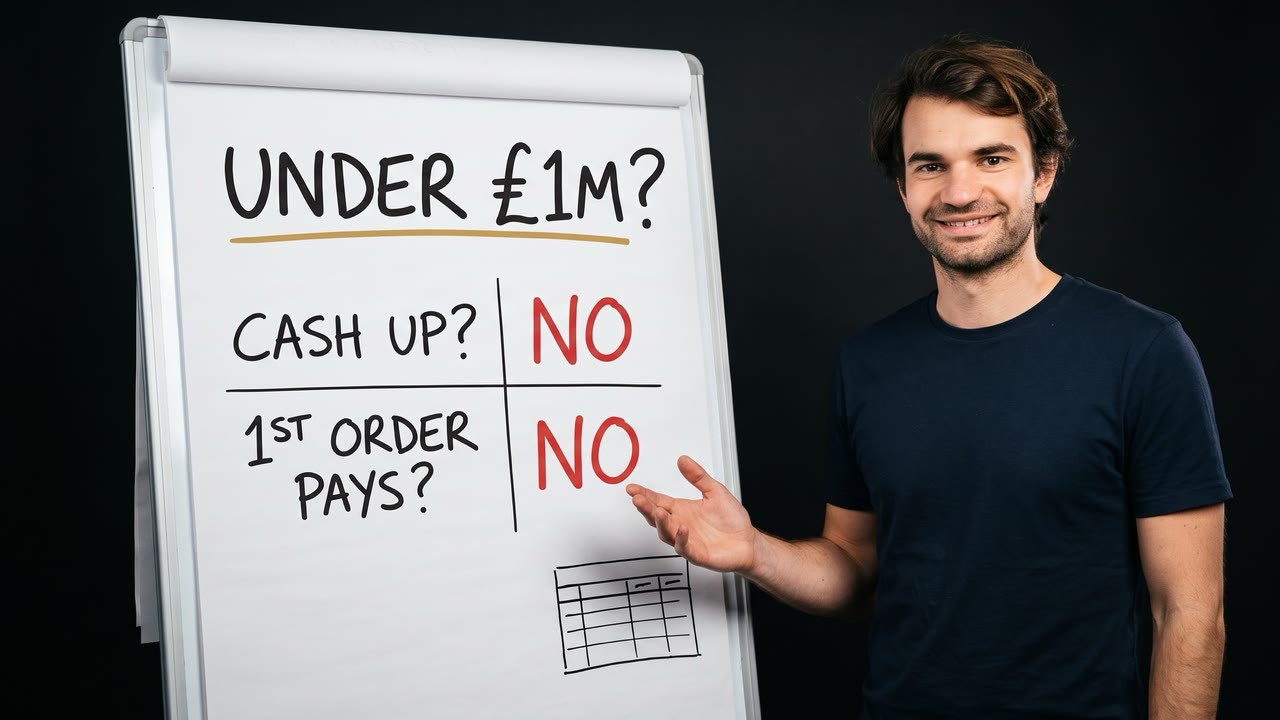
Answer two questions every month:
- Question 1Is my cash going up or down?
- Question 2Does a new customer pay for themselves on their first order?
Three numbers answer them:
- First-order gross margin, from landed cost (set up once)
- Cash balance at the end of every month
- CAC (what it costs to win a customer)
A spreadsheet for the three numbers above. Fill it in once a month and the two questions answer themselves.
Stage 2 · £1m to £3m
You're at Stage 2: Get good management accounts
The finance setup that gets you from £1m to £3m.
Read the transcript
You've made it to a million. Most businesses never will. But 93% of the businesses that get here don't actually make it to the next stage. Past a million, everything gets more complicated.
You've got rent, big stock orders, salaries. These are costs that don't go away when sales dip. So when things go wrong, they can go wrong quite fast. I'm Will.
I was an M&A banker working on deals worth over five billion. Then I built the finance function of an early stage DTC startup from scratch. As a fractional CFO, I've helped founders get their business to the next level by fixing the finance that was holding them back. Past a million, one number won't tell you anything.
Margin, CAC, customers coming back, stock. What matters is how all these numbers move together, because together they tell a story of your business, what it looks like and where it's going. Every month we need to read that story and answer three things. What actually happened?
Why did it happen? And where is everything heading? Now if you can't answer these three questions, it's most likely because your P&L looks like this. This is the classic export from accounting software, and this is exactly what your accountant prepares for you.
But the problem is this is in accountant language. It's not in founder language. So we need to translate this into something that we can actually understand. So there's a lot that goes into that translation.
We need accurate stock numbers, we need to properly break down all your expenses into the actual buckets that they sit in. And we need to combine this financial data with operational data to calculate the KPIs, which will actually show you the direction your business is heading in. We're going to try to understand what has happened with this business in the last 12 months. So in the last 12 months we can see they've done 2.2 million in sales.
They seem to have around a 40% gross margin. We have sales and marketing here, but it's very difficult to know what of this was brand and what of this was paid. Surprisingly, there's a ton of postage, freight and courier and not in the cost of sales, which plays into gross margin. So this should be up here with those gross margin costs.
There was 1.4 million of operating expenses, and so this resulted in a net loss of 75K. Pretty hard to understand what exactly was going on here because we don't have the proper gross margin number. So then let's take a look at the balance sheet to just understand where their cash is. So they started the year with 198 thousand.
And today they've gone down by around 68K. But generally speaking, it looks like things aren't going great for this company. But let's take a look at when we translate this into proper management accounts. So here's what I would build for this company.
We have a split in the revenue between the one-off sales and the refill, the subscription refill sales. On the cost of goods sold side, we have proper product cost which links to the amount sold for each period and not just what was bought in that period. So here we can actually calculate a proper gross margin and we can see this business is more in the 65 to 68% range. And here we can actually see that this has been going up.
We've properly broken out their marketing here, so we've split between performance marketing and brand marketing. This helps us to properly calculate a CAC over a 12-month period. So obviously we see the same starting and the same finishing cash number, but what we can really see here is there's been a lot of stock purchases, very recently a big one, which is why the cash balance is sitting quite a bit lower than what it was at the beginning of the year, despite the business operating very efficiently. So for me, I wouldn't be too worried about the cash level at the moment and the fact that it's down.
So now we look at the operational KPIs. So obviously first thing I spot is beginning of the year revenue growth was doing a lot better and it's really come off in the last couple of months. This is mainly due to the fact that the one-off business is completely died. It's now negative growth.
But the subscription business as well has also come off in terms of growth pretty significantly. So what exactly is going on here? Well, it looks like CAC has gone up over the year. It looks like first order profit after CAC is being reduced as well, and the blended CAC has also been increasing.
Despite the slowdown in growth on the one-off side of the business. We can see that net subscribers have been growing quite significantly over the last couple of months. So this is very positive to see. We can see that the business is really investing in its subscription side.
And this is probably what is leading to those higher gross margins that we talked about before. We can see that monthly churn is decreasing as well. So this is a fantastic sign, and that's really been pushing up the LTV. The increase in marketing costs has decreased LTV to CAC, but they're still sitting around an extremely healthy five level.
So overall the business is doing extremely well. So what would I tell to the owner of this business? Well firstly, first order profit after CAC is negative. So that means investing in the one-off sales is not the right thing to do.
So I would fully support them in reducing this sales channel. The subscription growth is still very healthy and they are also improving their lifetime value and churn rates. So I would consider investing much more heavily in this area of the business. It's clear that they have a better gross margin with the refill packs.
So this is clearly the way to go forward. One additional thing that I would note is that operating profit on average is pretty low in this business, despite marketing and gross margin being very efficient. So this would tell me that the salaries, rent, software, and other overheads are pretty heavy in this business. And this is something that the founders would need to look at if they believed that growth was going to slow down over the next twelve months.
So there we go. With the management accounts we've properly answered what happened, why it happened, and where this is going. This is something that I do for all my clients every month. You'll get a pack like this with your real profit, your real cash and the numbers that explain them.
We'll jump on a call together and we'll go through exactly what happened, why and what to change. So if you're between one and three million, book a call with me today, so we can set you up with monthly management accounts so you can start understanding what exactly is happening with your business and how to improve it.
What you need to reach the next level
The finance setup that gets you from £1m to £3m.
Four things to put in place:
- Monthly management accounts you trust
- Real gross margin, with stock valued monthly
- Real customer cost
- Where the cash went
The management accounts pack from the video, for a pretend deodorant brand: the Xero exports and the monthly pack built from them. Use it as a model for your own.
Stage 3 · £3m to £20m
You're at Stage 3: Use the numbers to grow
The finance setup that gets you from £3m to £20m.
What you need to reach the next level
The finance setup that gets you from £3m to £20m.
Four things to put in place:
- Management accounts plus a monthly cash forecast
- Scenarios for big decisions
- Investor and board reporting
- Debt to finance stock
The cash flow model from the video, for the same pretend brand: cash at the end of every month for the next 12 months, with an optimistic, base and downside case. Switch cases to see when cash gets tight.
Stage 4 · £20m to £50m
You're at Stage 4: Be ready to raise or be bought
The finance setup that gets you from £20m to £50m.
What you need to reach the next level
The finance setup that gets you from £20m to £50m.
Four things to put in place:
- Cohort-based business plan on LTV and CAC
- Integrated model
- Equity and acquisition readiness
- A cost base that flexes under scenarios
£50m Finance Roadmap
Four stages, from first sales to £50m
Pick your stage to see the finance setup you need and the video for it. From the free roadmap.